





 POLYWOOD
My Wishlist
Easily build your wishlists, or save them for later to add to the cart. Click here for details.
POLYWOODEasily build your wishlists, or save them for later to add to the cart. Click here for details.
Main Menu - Mobile

Whether it's time to replace your dining chair cushions or you want a few new throw pillows to brighten up your patio sectional, you'll need products tailored in materials rated for outdoor use. Before making any purchases, do some research to figure out what you need for your home.
Browse our guide to familiarize yourself with different types of fabric patterns and the outdoor materials used to make them. This helps you find the right style of textile on the first try, which saves time, money, and stress.
Patterns fall under one (or more) of these five main categories:
This repeating pattern features geometric shapes and lines that combine to make a cohesive design.
The checkered pattern consists of intersecting vertical and horizontal lines that form squares.


This is a common pattern of repeating zig-zag stripes shown in two or more alternating colors.
Vertical diamonds are stacked end-to-end in this repetitious motif.
Similar to chevron, the herringbone pattern consists of broken zig-zag lines.
Commonly depicted in two-tone black and white, houndstooth is a distinctive checked pattern with irregular four-pointed shapes.


This genial geometric pattern consists of same-size, evenly spaced circles blanketing a solid background.
Rows of vertical or horizontal lines in two or more colors that can be uniform or vary in width.


A pattern showing horizontal lines and vertical stripes crossing at right angles to form a square-like design.
Realistic patterns mimic natural or human-made objects, such as architecture or vehicles.
Floral designs show flowers in repeating patterns. Flowers fit in with just about any design style, and their versatility makes them some of the most common fabric patterns.
This realistic motif is covered in illustrations of herbs, plants, and other flora.


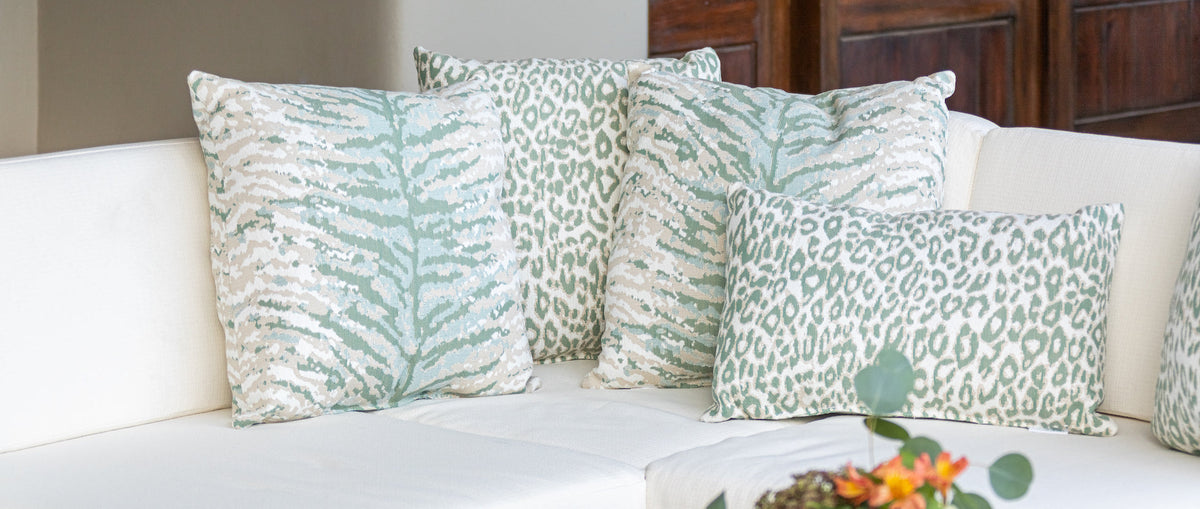
Zebra, giraffe, and leopard print fabrics are popular in the furniture and clothing industries. They are often made to closely resemble the real thing but also come in unexpected colors or painterly designs.


This European design pattern is typically characterized by detailed, repetitive pastoral scenes. Historically, toile was printed in one color over a white background.
Showing wide outdoor scenes like mountain vistas or ocean sunsets, these types of patterns repeat horizontally but not vertically.
A stylized motif depicts objects in exaggerated, simplified, or distorted ways to create a dramatic impact.
Chinoiserie style originated in 17th-century Europe and borrows inspiration from Asian motifs, architecture, and materials to show romanticized and playful illustrations.
This is a small-scale print that's meant to look random. Tiny flowers, small dots, or itty-bitty birds in bright colors are blanketed across a solid backdrop.
Beloved by French royalty, the design shows a three- or four-petal lily replicated across a solid background.
Also called “meander,” this interlocking square-and-rectangle scheme is created by one continuous line.
Medallion designs are circular, square, or diamond-shaped, and can be echoed over a backdrop or show one central point.
Two continuous S-shaped lines mirror each other, creating oval shapes every time they connect.
This teardrop motif is intricate, curvy, and often portrayed in vivid colors.
Curved or angled lines are interwoven to create a lattice-like design.


Here's an ornate design featuring a mix of vines, scrolled leaves, and other whimsical floral patterns.
This is an Indonesian dying technique where threads are tie-dyed before they're woven into ornate designs.
Abstract patterns are based on ideas instead of objects. They may look like unrecognizable blends of shapes, colors, and qualities, but these designs are carefully organized and filled with meaning. Abstract motifs are either printed or painted on fabrics.
This design is meant to look like paint was artfully flung onto the fabric by a free-spirited artist.
This pattern features thick-lined blocks of varying shapes and sizes filled with bold colors.
Inspired by the ancient Japanese art Suminagashi or "floating ink," colored ink is added to water (but not mixed in) and then poured over fabric to create a marbled look.
A blocky and angular pattern, cubism shows fragmented and geometric objects that are somewhat identifiable—and everyone sees something different.
Simple, clean, and beautiful, this abstract design uses continuous lines to form surreal shapes.
Emphasizing bold colors, geometric shapes, and the blending of different patterns, Memphis style embodies the joy of experimentation and discovery.
Giving a nod to natural colors, materials, and textures, this pattern consists of curvy shapes in muted shades.
When images are taken from solid shapes to series of dots, they can be described as halftone.
Distorted reality is what surrealism is all about. This type of design is meant to be odd and unconventional, combining objects and scenes that don't go together in real life.
This stitching technique creates a wavy pattern resembling flames.
Textural fabrics can display a variety of patterns, but what sets them apart is the materials and methods used to create them. Various threads and weaving techniques can create textured materials with distinct tactile differences.
Matelassé is a weaving technique performed on a jacquard loom. The resulting raised design appears thick and padded.
This pattern is loom-woven with an elaborate raised design.
Like brocade, damask is woven on a loom. It's a scrolled motif created with a blend of warp and weft threads.
This tonal textile is designed to resemble a woven basket.
Read about the different types of performance fabric to learn what they're made of and the best uses for each.
This type of textile is dyed before the fibers are formed. Color is added to a liquid acrylic solution, strung into thin threads, and spun into yarn. Materials woven from solution-dyed acrylics are commonly in umbrellas and awnings, with softer versions available that are ideal pillow and cushion covers.
Unlike solution-dyed acrylics, acrylic-coated polyester fabric is spun first and then dyed. This material is resistant to fading, stretching, and wrinkling, making it a popular choice for car and boat covers, umbrellas, and outdoor curtains.
This fabric starts as a blank acrylic or polyester base cloth, with schemes screen printed on the surface using UV-resistant dyes followed by a clear, water-repellent coating. Since it's easier to put abstract and intricate patterns on printed acrylic and polyester materials, they're best used in applications that draw the eye, including throw pillows, seat cushions, and tablecloths.
Commonly known as "sling fabric," this durable mesh is made by coating polyester fibers (or a polyester-acrylic blend) in waterproof liquid vinyl. This open-weave fabric is soft to the touch and flexible but can easily handle tough jobs and harsh weather—it's a preferred material for tote bags, tennis court nets, tarps, seating, and furniture upholstery.
This heavy-duty performance textile is typically woven from cotton or linen, but it can also be made using other natural or synthetic fibers. Canvas is commonly used to produce furniture, backpacks, tents, and sails.
Olefin is made from ethylene and propylene in the same method as solution-dyed acrylics. Manufacturers use this durable performance fabric in attention-grabbing furniture, curtains, and cushion applications because it's easy to use in a variety of weaves, textures, and prints.
A print is a design that has been printed onto fabric, whereas a pattern is a type of design that repeats itself. Patterns can be printed, woven, painted, or embroidered onto fabric.
The best color for outdoor fabric should be easy to keep clean and maintain its vibrancy. Many outdoor fabric brands, such as Sunbrella® and Revolution Fabrics offer performance fabrics in a range of colors suited to your space and are inherently fade-, spill-, and stain-resistant. Look at neutral tones if you want versatility or vibrant hues for something more daring.
You can spritz fabrics with protective sprays to guard them against water, stains, and UV radiation. Look for products made specifically for patio furniture, and read product labels first to ensure it's safe for your intended surface.
Are you missing items in your cart? Sign In


